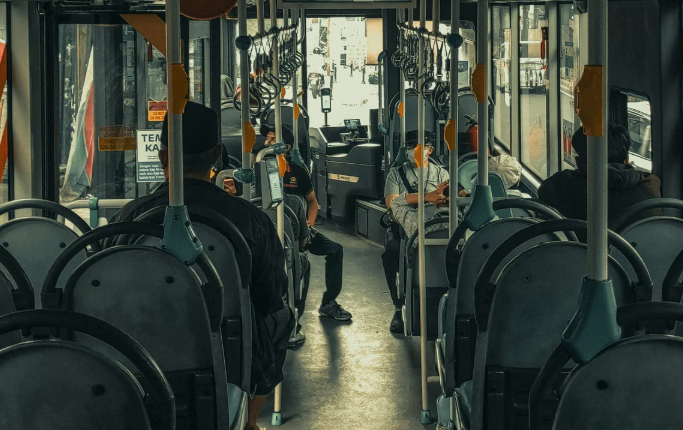
Labor shortages are one of the most talked-about challenges in Iowa's economy right now. Employers struggle to fill open positions and turnover is high. According to Iowa Workforce Development’s Employer Needs Assessment, nearly 65 percent of employers say they have difficulty hiring, and more than 28 percent name turnover as a major challenge.
These conversations usually lead to familiar explanations… Skills gaps. Demographic shifts. Wages. And those things are real. But there is another factor that rarely gets named directly.
Transportation.
Workforce transportation sits at the intersection of three systems that rarely coordinate with one another: public transit, private vehicle ownership, and employer hiring needs. Each functions reasonably well within its own boundaries. The problem shows up in the space between them, and that is exactly where many Iowans are stuck - and trying to get to work.
Iowa’s workforce is more regional than most people realize.
Nearly one in four Iowa workers, about 318,000 people, commutes across county lines to reach their job. More than 106,000 of those workers make rural-to-urban trips into Iowa’s five major employment centers every day: Polk, Linn, Scott, Johnson, and Black Hawk counties.
These are not occasional trips. They happen before dawn and late at night, along routes that connect small towns to industrial corridors, rural communities to regional medical centers, and outlying counties to the places where jobs are concentrated.
More than half of Iowa workers are in jobs that require physical presence, including healthcare,
manufacturing, and production roles, often on shift schedules and located far from where workers can afford to live. The question is not whether people are willing to work. It is whether the system makes showing up possible.
Seventy-six percent of Iowa workers drive alone to work. Fewer than one percent commute by public transit. That statistic is often read as preference. Iowans get a car the day they turn sixteen, the thinking goes. But the broader data tells a different story. Transit ridership across the state has declined 35 percent over the past decade, and 22 of Iowa’s 99 counties have no recorded transit riders at all.
When entire counties have no riders, it is not because residents collectively decided they dislike buses. It is because the service either does not exist, does not reach where people work, or does not operate when they need it. This is not what preference looks like. It is what the absence of an option looks like.
Vanpooling emerged as one practical response to this geography. Shared vehicles run county-to-county routes and connect workers to job sites that traditional transit cannot easily reach.
Before the pandemic, DART’s regional vanpool program logged nearly 9.6 million passenger miles each year, with close to 100 vanpools operating across county lines. But vanpool programs carry their own vulnerabilities. Many rely on volunteer drivers, which means a route can be disrupted by one shift change or one person no longer able to drive.
When the pandemic hit and volunteer drivers started working from home, entire vanpools, sometimes carrying up to 14 passengers, lost their route overnight. By 2021, ridership had fallen nearly 70 percent.
Not because demand disappeared. Because access did.
That is what makes workforce transportation so difficult to solve, and why no single mode of transportation can solve it alone. Fixed-route transit works best where there is density. Vanpools connect workers across county lines when schedules align. Employer shuttles can bridge the last mile between transit stops and job sites. Private vehicles carry the people the system does not yet reach. These are not competing solutions. They are components of a toolkit that, when coordinated, can cover the geography and schedules that any one transportation mode leaves behind.
Here is what is easy to miss: when workforce transportation works, people use it.
DART’s vanpool program has operated continuously for more than 30 years because demand has always been there. Even through recent disruptions, it still logs more than 27,000 workday commutes in a single fiscal year.
Iowa also has more than 77,000 households with no vehicle at all, representing about 126,000 people. Nearly two-thirds are single-person households, not families who can share a car, but individuals waiting for a system that makes getting to work possible.
Transportation access is not only about movement. It is about participation: in work, in healthcare, in economic stability.
Workforce transportation is not a single program or service. It is an ecosystem, and the gaps in that ecosystem are costing Iowa workers, employers, and communities more than most people realize.
What makes the challenge persistent is not a lack of ideas. It is the absence of coordination between the tools that already exist and the ones still being built. Transit agencies, employers, and workers are each navigating the problem from their own lane. The opportunity is in the connections between them.
That is what workforce shuttles represent: not a replacement for fixed-route transit or vanpooling, but a bridge purpose-built to reach the job sites, shifts, and geographies that the existing system was not designed to serve. When paired with vanpool and fixed-route options, employer-supported shuttles can extend the reach of the whole network.
The question facing Iowa is not whether workforce transportation matters. The data already answers that. The real question is whether we are willing to build the full toolkit and treat workforce shuttles as the serious infrastructure investment they are.

Advocates connect through a shared commitment to improve health outcomes.

Amal Barre's research and advocacy efforts address housing instability and the sense of belonging in the community.

New report highlights central Iowa Latinos contributions and disparities and elevates Latinx leaders

Outcomes from Mid-Iowa Health Foundation's HealthConnect Fellowship, October 2019-June 2021

How nonprofit leaders brought attention to the Latinx community and built new systems of support during the pandemic







.webp)


